
Lisa Purdy ND, MH, CNHP
What kind of garden do you want?
Dream BIG! Visit other gardens and note what you like. Take photos of ideas, observe layouts and specific growing habits of plants. Visit the library and check out books on gardening and landscaping to give you ideas.
My favorite garden: Inniswood Metro Gardens in Westerville, OH
Some favorite books:
Grow Your Own Herbal Remedies
by Maria Groves
The Herbalist’s Garden, a Guided Tour of 10 Exceptional Herb Gardens
by Satoiya and Richard dela Tour
The Healing Garden
by Juliet Blankespoor
The Medicinal Garden, How to Grow and Use Your Own Medicinal Herbs
by Anne McIntyre
The Well-Tended Perennial Garden, Planting and Pruning Techniques
by Tracy DiSabati-Aust
Work with what you have. Be realistic about your space, time, and budget. Look at your land, buildings, paths, trees, fences, pergola, patio or deck and choose a location. Do you have sun or shade in your garden?
Choose a style. Ideas might be a four-square, apothecary, knot, wheel, ladder, rock garden, raised beds, or an herb border.
Choose a theme. What is your garden’s purpose? A kitchen garden, medicinal, tea, cosmetic, aromatherapy, herbs for attracting bees and butterflies, or a specific color.
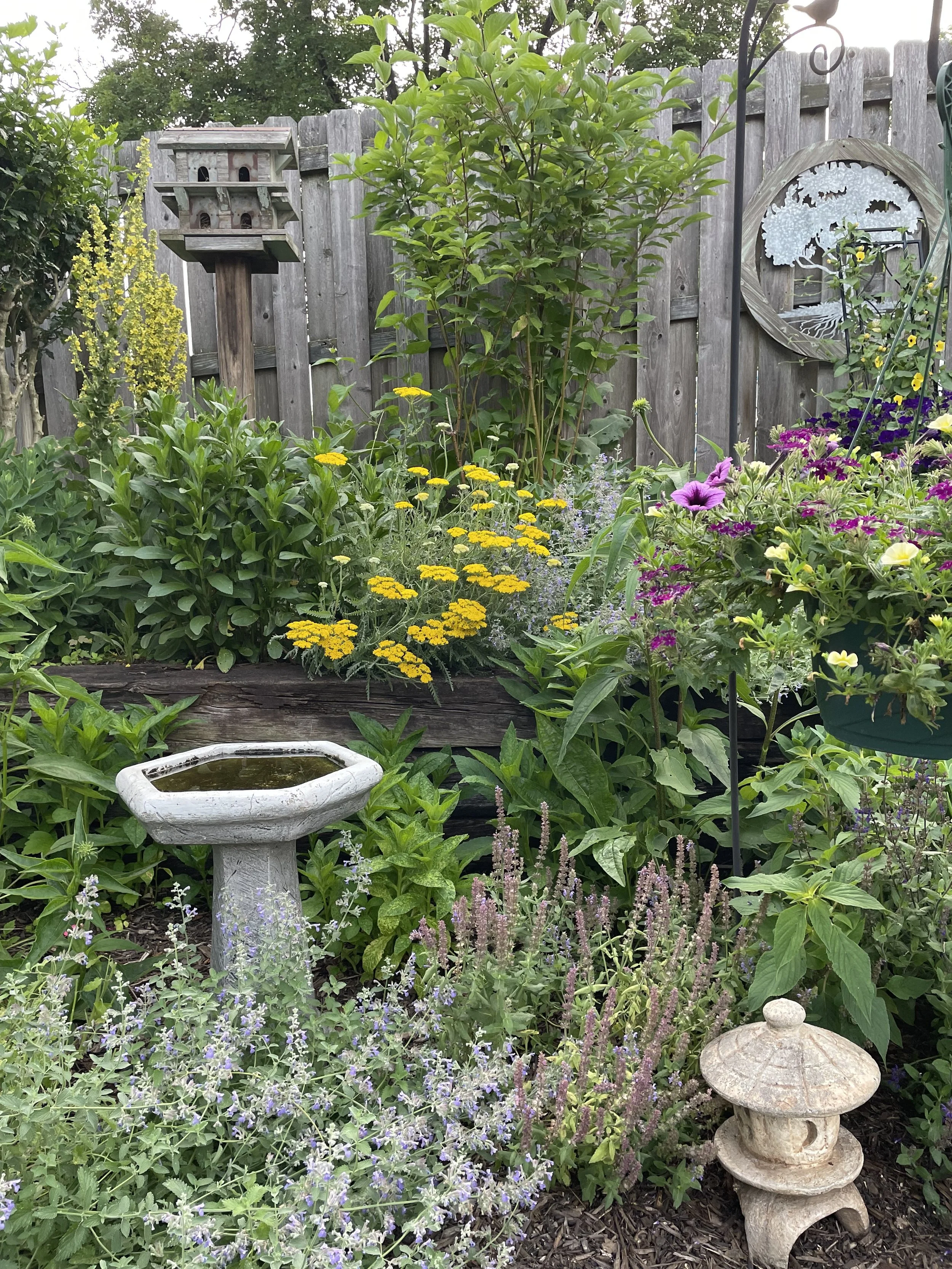
Every garden needs a focal point. What is the most prominent thing you see? What draws the eye? Add a pergola, trellis, tree, birdbath, statue, bench, art, wheelbarrow, wagon wheel…or even a pop of color.
Prepare the soil. Remove sod, weeds, and rocks. Double dig the area or use a rototiller. Add manure and compost.
Choose your plants. It is helpful to draw out a plan on paper and then make a shopping list. You must think of shape, size-height, habit, color, and texture of the plants. Use balance and repetition. I like to plant in odd numbers, groupings of 3’s and 5’s, unless the plant is large enough to stand alone. Consider the planting zone of your area, Ohio is zone 5-6. Note whether the plant is a tender perennial, perennial, biennial or an annual.
Choose healthy plants and plant in the early morning or evening, when the sun is not hot. Use a hose or rope to map out large sections. I like to use flour to divide planting areas and show where each plant should go. Set the pots into their places, adjusting the plan as you lay them out. The frost date in Ohio is May 15th, so you can safely plant tender perennials and annuals after that date. Perennials may be planted earlier, as can many seeds.
Dig a deep hole, fill with water, remove the plant from its pot, loosen the roots, place it gently in the hole, cover the roots with dirt, and press down all around the plant. Mulch can keep the weeds away. Remember to water new plants frequently until well established.
Keep a journal of how your garden grows. Note general information about each plant, which will be helpful in making decisions for next year. A gardener’s work is never done – there is always another plant to grow. A garden is never perfect, one plant is dying, one is just beginning to bloom - enjoy the continuing process.
Happy Gardening!